Wednesday, February 9, 2011

Open Access

Medicine lives in the shadows of vulnerability. The granite conformity that exists if peeled would reveal the distortions and countless contrary opinions. Each layer has been imbued with the color of discord.


The medical venue is rich in its diversity in spite of the outward image of uniformity. For so long the shroud that has covered - protected that image, is finally being swept away. The hidden knowledge up until now available to a select few is falling in the hands of all. No longer does one have to find and comb through the journals stored away on shelves of a hard to access medical library. The written word once ensconced in the hallowed halls is at the fingertip of anyone with access to a computer jacked into the Net. This medium not only allows the ability of fast access but also allows those hitherto with dissenting voices to express their rants to merge with the raves.

                            Disciplines and Open Access to Information

The tedium of the glacial paced written word on a journal’s page is now available instantly and open to question. The richness of differing opinions prevents a well-articulated -but minimally reviewed article, to become the hard currency of thought. Previously this currency, could lay its foundation into the minds of many scientists and physicians and become permanently inked. It would become the style of thought and the mode of action. But that is a-changing.

The past although rejoiced for its many advances has also been the historical review of too long entrenched a thought that went unquestioned for too long. The promoters of such thought for whatever reason, either drenched in egotism or delusional perceptions, failed to call their own data into question. Now change is afoot; the thousands of pairs of eyes that review such information are armed with easily available broad spectrum of knowledge that can critique any potential error before it gains semi-permanence.

Open access is ready to revolutionize the science and soon in the near future, the art of medicine. But there are flies in the ointment; if the finder of the research pays for the online publication for open access then one might consider a conflict of interest, or if the peer evaluation process is based on "single blind" analytical review then bias can creep in. Here lies the broadened knowledge base of the reader, who, given this open access can now make a critical and qualified evaluation of the study for all to consider. The process does and will on a rapid basis weed out the charlatans. The written publication which, moves at a glacial pace from completion of the study to information dissemination for consumption, equally hampers the flow of criticisms in letters to the editors taking even larger parcels of time to get through to the authors, makes the old printed publication process archaic.

History has taught us that a published journal article without the applied criticism can become ingrained into the minds of the scientists especially the physicians and thereby can alter patient care and management. Equally this sluggish pace leads others to using the "published article" as a reference in future studies thus contaminating and obfuscating the truth.

                                                    Dr. Anil Potti

A recent case of a Duke University scientist, Dr. Anil Potti grabbed headlines when his study could not be reproduced by others but at time of discovery, Dr. Potti's article had been cited 100 times in the scientific literature- the contamination had gone "viral." The drama has ended with his resignation from the university. Other notables of ill-repute in the recent past include; Maria Carmen Palazzo, a psychiatrist on the payroll of GlaxoSmithKline has been sentenced to 13 months in prison after pleading guilty to committing research fraud in trials of the company’s antidepressant Paxil on children. Dr. Scott Reuben, a Massachusetts anesthesiologist with several hundred papers to his name, 21 of which were found to be pure fiction pleaded guilty to charges of research fraud in 2010.
                                                      Dr. Scott Reuben
The dilemma of fraudulent research is significant; Dr. R. Grant Steen in the Journal of Medical Ethics reported that 788 retracted papers from 2000 to 2010. Steen's research found that U.S. scientists were lead authors on 169 of the papers retracted for serious errors, as well as 84 retracted for outright fraud. This practice, although rare in overall terms (1 in 6109 published paper is retracted or 0-0164 retraction rate) is also prevalent in other countries: China with 89 retractions, Japan with 60 followed by India and the United Kingdom.
Additionally there is monetary cost associated with this fraudulence. Researchers from the Roswell Park Cancer Institute in New York has developed a model that estimates the monetary costs of scientific misconduct cases placing a direct cost of investigation for each case at $525,000.00 or $110 million for 217 cases of alleged misconduct in 2009.
Today's headlines are tomorrow's footnotes and day after tomorrow's retractions. The open access process would, given a wide net of critical thought, clear the cobwebs of improper technique, observer, selection and a whole host of biases with quick dispatch. Although hoped but improbable, it certainly will not weed out all bias or errors and in fact it might add unneeded and questionable comments, but on the whole it will purge the unnecessary, the delusional, the slipshod- intentional or otherwise, the dogmatic and the unexamined axioms of scientific arguments. The discordant clamor and exposed inattention from diverse viewpoints will loosen the grip of firm misconceptions revealing a better reality.

Medicine is at the threshold of a transformative change. Open access will enable a larger number of researchers and would-be researchers to have access to information that might lead to new ideas. Each new idea can generate a new hypothesis and thus a new scientific breakthrough. This arborized venous knowledge base will herald a new era in understanding. A minority opinion based on legitimate scientific research can call to question the stranglehold of the conforming thought. The partitioned cells of knowledge will coalesce into an amalgam of rich diversity easily harvested for use.

Suppose you want information about a specific gene function and related research, it will be a click away. The isolation between scientists will end and even though the desire to compete for the top prize will always linger, as it should- since we are humans, the shared information will give others in the field help with their own research. More importantly it will bring the breakthroughs closer and faster to the practicing clinician who can formulate the best plan for his or her patient.

Where does one go today in search of this scientific grail?

There are easy search engines that provide free information backed by peer-reviewed scholarly information. The list by no means is complete but serves as a starting point.
There is a vast growing library that can be freely accessed today: Directory of Open Access Journals: http://www.doaj.org/doaj?func=findJournals In Health Sciences alone there are 422 journals dedicated to General medicine, of which 252 are  internal medicine related, 78 are surgery specific publications and 70 related solely to oncology.

Among the many other free access areas, included below are a few that can be accessed via computer or through iPad apps:

PubMed. This excellent resource gives abstracts of all available information in its database. There are free full text articles also available. Those that are in abstract form can be purchased through a separate online source. But the diversity of the information available makes the search more productive for a specified query. An app for the iPad is also available.

Medscape: This resource is an excellent collation of recent scientific data well referenced by peer-reviewed scholarly articles. An app for the iPad is also available.

Google Scholar: The references mentioned here are similar with an as yet smaller database than that which is available in Pub Med. But it is growing rapidly.

PLoS (Public Library of Science): This online service has scholarly peer-reviewed new articles unpublished elsewhere open access for all. The references are excellent and an app for the iPad is also available.


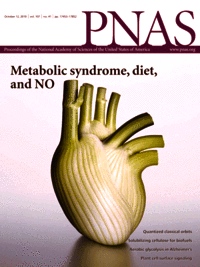
PNAS or Proceedings of the National Academy of Sciences is considering online publishing (PNAS Plus) as a major format starting in 2011. Other major leading widely read scientific journals including Science, Nature, JAMA and Cell amongst others are also online bringing abstracts and an occasional full text article to the public for free. Times-are-a-changing when 20% of all peer-reviewed scientific articles are available through open access!

These examples are heralding a future of intellectual properties freely available to all. Some are free and some tease with abstracts only, hoping to sell entire articles for a price, I believe time will dispel such pecuniary limits.

And although open access is the wave of the future, just like any other new paradigm its control has to remain with the users. A worrisome historical record encountered in the book “The Master Switch” by Tim Wu suggests that when a technological breakthrough paradigm sprouts its wings, there is a desire by some elite to control and manipulate it. Vigilance, in a dialogue for openness will always be a prerequisite for open access survival.

Saturday, January 29, 2011

Courage!


“I am frightened!” she said, her blue eyes wide with anxiety. Who wouldn’t be frightened when confronted with a diagnosis such as hers’ I thought.  Her face was flushed with mixed emotions. And as she uttered the words, tears welled over her lower eyelids threatening a torrent.

“Don’t be frightened.” I said to the 16 year-old, who lay in the bed like a limp doll.  I could see that fear had manifested itself within her tiny form. The three words might have had a calming effect on her or it might have been the stethoscope dangling around my neck or maybe my white coat might have projected some authority over her malady and then again it was her emotional reset. Whatever it was, it seemed to quiet her senses a bit. Her eyes stopped darting left and right looking for answers from the ghost of the future. Her stilled gaze looked right through me in search for answers. After all I had the knowledge and experience to afford those answers.

“All I said was that I felt tired, to my doctor and before you know it, here I am.” She said with agitation in her voice and visible tremors in her expressive hands, as her thumbnail were busy in a nervous ritual of ridding the demons from beneath her fingernails. “And now they tell me that I might have can…” her voice trailed into gentle sobs, unable to finish the word. All this happened under the scrutiny of the stuffed pink teddy bear that sat next to her bed in stony silence.

“I know that this nightmare will end soon and you can go on to live your dreams. I also know that your dreams will change somewhat as a result of this but it will be for the better for you and everyone else around you.” I said quietly and as calmly as I could manage without exposing my own emotions of “Why?” and “Why her?” It was important for her to feel hope. “You will have some difficult times initially but we will guide and help you through it.” I added giving her some sense of truth and reassurance.

As I turned to leave her bedside, her right hand shot up and gripped mine, her eyes pleading for something to hold on to and as she did so her eyes gazed right into mine, rooting me to the spot, where I stood.

She did not say a word while she held my hand but continued the unblinkingly stare. After what seemed a long minute her grip loosened and then with her eyes lowering she mumbled a “thank you.” I replied with a “you are welcome,” but did not know what I had done to deserve that.

The next morning her case was presented to the “Intake Conference.” Most of the medical staff was there. Some with coffee mugs and others still with bleary eyes that even coffee could not blow the cobwebs of their sleep deprivation.

She had an uncomplicated case of Acute Promyelocytic Leukemia.

 The APML was a garden-variety type with its standard translocation of the t(15;17)(q21;q12) and expression of the RARa gene. 

The only problem was that she was younger then the average patient with that disease. However, after half hour of mind melding, thoughtful criticism from the assembled group a decision was made and her treatment was started the same day.


I remember that day vividly. It was a frosty November morning. It was a kind of a virtual memory milestone, with autumn leaves covering the driveways and the lingering chilled breath of those people walking on the sidewalks. That was the day we embarked on a journey together; her in her darkened world and I with a team of others working to make her world brighter.

Nothing extraordinary happened until the third month of her therapy when she developed a fever. It seemed like an interminable time to diagnose the cause of the fever as each hour her pulse and respiratory rate rose and her blood pressure lowered, finally the clarion call of sepsis sounded through the unit and she was transferred to the ICU. IV-Bags filled with antibiotics, anti-fungals and anti-virals were pumped into her every four hours. After days of fighting the vile element, that was never identified, the slow process of healing began. She had marshaled her youthful reserves to allow her to sail the stormy seas. She had survived.

I remember also the slant bright morning sunlight of the March sun filtering through the windows as she sat in her wheelchair in the lobby waiting for her ride. A swarm of well-wishing nurses by her side joyous in their dialogue and happy in this circumstance all animatedly talking, kissing and hugging her. I stood by the window looking at the proceedings. Even though I was partially hidden, I saw her raise her arm towards the window and wave. I waved back with a smile and then it was all over. Hearing my name announced over the overhead speaker, I was back tending to the sick once again, the sight of her leaving the hospital firmly locked in my memory. It was a triumph of human resilience and courage. And, boy what a fighter she was, the best I had, had the privilege of caring for!

Two years later as I was winding down my fellowship in hematology-oncology, sitting in my cubicle with papers strewn over the table, frustrated in trying to resolve the scientific paper, I was writing. With my head in my hands the problem seemed insurmountable at that moment. A soft knock alerted me to someone’s presence. I turned to look and there stood a young woman. Her face was full of life and her blue eyes caught my attention. The slow spread of recognition in me must have shown on my face for as I stood up I must have broken out into a smile that probably ripped my ears of the edges. She smiled back and held out her right hand that I took and for a moment she did not say a word. Then after what seemed like a while she let go of my hand, “I came to give you back what you gave me two years ago and thank you for all you did.” Speechless and still smiling all I could say to her “thank you,” was “you are welcome.” And before I knew it she was gone. That same evening, I competed the article, I had been working on and sent it for peer-review.

 I have often wondered at the many blessings that come from being a physician and never has there been one that has so filled me with utter joy then the memory of that encounter. I have often wondered at what it truly was and now maybe, I think I know. It was the touch of a concerned human for another to lift her out of her despair and give her the strength to fight the fight and win. Sometimes a simple act of a smile or a touch means more than a thousand words.

also published (without images) in Oncology Times:
Voices 
Opinion articles 
Sunday, January 23, 2011Author 


Monday, January 24, 2011

Paradigm Shift


Today I thought of asking the question. What is a paradigm and how do they happen? First you have to agree that a paradigm is a mental construct. It is not really a feel-able, touchable smell-able entity. It is viable only in the brain. It is a kind of a mental note.
For instance if a person were to state, “This is a new paradigm!” What does that person mean? Is he referring to a product or the meaning of the product as it relates to social interaction between us, Homo sapiens? Is paradigm-shift therefore a referential construct?

On a very small-scale, there is an understanding between humans; for instance between me and you, the reader, unless you disagree, in which case you are entitled to your voice as always and carry your own paradigms in your head, but just in case you do agree, then wouldn’t you accept that individual concepts in my brain are personal and therefore differ from the concepts in your mind. So, then we have small-scale paradigms within each one of us. Large scale ones are those where several people agree to agree and small scales ones are within the confines of the invisible castles of our existences where others may agree to disagree.

The next question arguably would be what makes a large-scale paradigm happen? How do large groups of people agree to agree and therefore tenably create this phenomenon that all viewers of that phenomenon consent to force a frame shift in the concepts of belief. Let me give you an example so that we can go from the abstract to the real.


Imagine the building of the wheel. According to archaeologists, it was probably invented in around 8,000 B.C. in Asia. The oldest wheel known was discovered in Mesopotamia and probably dates back to 3,500 B.C. The wheelbarrow was first invented in ancient Greece. Two building material inventories for 408/407 and 407/406 B.C. from the temple of  Eleusis list suggest such timelines. This circular object made of troglodytic material used by our ancient ancestors changed the game of mobility. They were able to traverse distances in search of food and water and a better life through migration on land, move material and foodstuff and engage in trade. The spread of civilization may have been on the primitive wheels made of wood. That, you would agree would be considered a paradigm shift since it made large scale changes in human migration which then added diversity within communities as different groups with varied cultures met and got assimilated into the whole. It made for progress; there were more hands on the till as more people were involved with hunter-gatherer operations as communities to keep their home fires burning and better fed families began to emerge with more robust children.

                                            Antique Spinning Wheel

The thrust for survival in other species made the primitive man invent weapons to protect himself and his creed from invading forces of these predatory animals. In doing so he was also able to lord over the animals for his own survival. The use of the flint for an arrowhead, spearheaded the beginnings of hunting and gathering. This ancient tool dates back to 7000 BC and might also be considered a paradigm shift on an evolutionary scale.

                                                  Flint Arrowheads (circa 7000BC) 

As certainly as the growth of the human population began to excel, in its climb the ladder of the evolutionary tree, to conquer the mantle of the “intellectual-knowing species” so too did the dynamics of the littlest of creatures change. Every species wants to survive, thrive and procreate. It is within the DNA of every living organism that it must procreate and replenish. Darwin spoke about the “Survival of the fittest” and he was right as we find that 3 species go extinct every hour and the planet has been in that mode for the known history of life cycles of species as evidenced by the fossil data. Those that survive, well they have the wherewithal to counter all attacks from predatory forces and those that don’t, perish into the pages of the fossil data. The survivalist attributes must continue even to the littlest of all creatures including viruses and bacteria.

Man and his intelligence came to understand that disease at least in the earlier phases of humanity was linked to unseen critters that would invade the body and cause illness and death to the humans. The recognition of these little “critters” and then how to deal with them was, you would agree a paradigm shift. Martinus Beijerinck discovered viruses as “infectious agents” in a bacteria free culture medium in 1898 and not until 1935 did the first electron microscopic picture of the TMV (Tobacco Mosaic Virus) was seen by human eyes.

                                          TMV (Tobacco Mosaic Virus)

So as humanity would, do as it does best, instigate scientific curiosity and in doing so demand a means of circumventing the “raids” of these “little critters” on the human body. The fever previously treated with “blood-letting” had morphed into poultices and ingestible materials from the apothecaries. Given the new tools of the trade another paradigm shift was to occur shortly.

And it did. Along came the likes of Louis Pasteur who discovered the germ theory of transmission followed by Edward Jenner who discovered cowpox vaccination abolished smallpox, followed by Alexander Fleming who discovered Penicillin from a fungus for treating bacteria. These great men were pioneers for they raised the bar on human intellect and helped increase human longevity.

As insight into the chemical structure of penicillin was discovered another shift was to become a reality. Companies starting with one or two individual members/workers grew into pharmaceutical behemoths creating the next greatest antibiotic and antiviral agent that they could devise in their labs. This was and is all for the good and preservation of humanity. And this is as it should be. But there lurks, somewhere another shift in the making that might be seismic in might and catastrophic in casualties, just beyond the horizon. We don’t see it but it is there. It might be in the form of a mutational change in the very structure of the virus or bacterium that may render us helpless, due to the promiscuous and profligate use of antibiotics, antiviral agents or, it may be another zoonotic illness that might transgress the limit of one species and jump to the humans as HIV did, or it might be a virus cultured in a laboratory mutating in a tiny Petri dish that finds its way from the sealed airtight confines and travel outside to make the human its host. We just don’t know when this might occur, but occur it will. Remember the movie “The Andromeda Strain!”


The 1918 Influenza epidemic is a perfect example of large-scale human life loss from a virulent and mutant virus that wiped out millions of its victims. We already have seen the emergence of MRSA (Methicillin Resistant Staphylococcus Aureus) and VRE (Vancomycin Resistant Enterococcus), resistant TB and a killer Poliomyelitis in an Indonesian city of Cidadep. The list goes on. The shores are inviting and the uninvited guests are arriving.

Speaking of viruses they are the self-starters and very smart in their survival since they constitute the largest population on this planet. If you saw the movie “War of the Worlds” the concept of exposing an alien population to the lethal attacks of this tiny entity (flu virus) can bring down aliens and their space ships.


 It can do the same with the human race if it arrives in a different form with different “clothing” that human immune defenses cannot identify. The virus and bacteria mutate to survive just like we create newer “anti-agents” against them for our own survival. And the battle goes on. The one with the better abilities will win.


Another surreptitious and incipient paradigm shift that has occurred over the millennia is the cohabitation by the viruses within the humans. The bacteria do it in the human GI flora, skin and elsewhere where they provide beneficial effects for their hosts and survival for themselves. The viruses have inserted their DNA within the humans and that resides in our chromosomes as “junk-DNA” or Introns. Thus embedded within the human genome they have modulated the human history.

                                                  DNA Double Helix

                                                         RSV transfection

Viral oncogenes were first defined in RSV, (Rous Sarcoma Virus) which transforms chicken embryo fibroblasts in culture and induces large sarcomas within 1 to 2 weeks after inoculation into chickens. In 1976 Harold Varmus, J. Michael Bishop, and their colleagues,  showed that a cDNA probe for the src oncogene of RSV hybridized to closely related sequences in the DNA of normal chicken cells as the culprit for the sarcoma induction. 


Direct evidence however for the involvement of cellular oncogenes in human tumors was first obtained by gene transfer experiments in Robert Weinberg’s laboratories in 1981. 


The genomic revolution had begun. A paradigm shift in how we view disease was taking shape and treatment of disease would never be the same.


The human history details shifts in human thinking and behavior. Paradigm shifts occur either at a slow steady state or as a veritable “bolt from the blue.” This bolt is placed at the doorstep of humanity by an outside-the-box-thinker. Galileo’s heliocentric view in agreement with Copernicus was one giant step. Newton’s Laws of Motion inspired physics, Edison’s electricity, Alexander Bell’s telephone, Einstein’s theory of relativity are all seismic upheavals in the understanding by us of ourselves and the planet we inhabit. These would be called in today’s lingo; “Game changers.”

It would not be correct if I did not mention two individuals who have transformed the recent landscape of how we interact and communicate and how we all view and relate to each other. These two have the distinction of spawning an industry that helped initiate the DARPA project precursor to the Internet boom; Steve Jobs, CEO of Apple and Bill Gates, the former CEO of Microsoft Corporation. They wrote on their blank slates and transformed us from writing on paper to clicking keyboards and sending mail via postal service to instant gratification with written communication, to video conferencing and cloud computing.

The massive shifts that are in the making through technology will change culture, humanity and our view of the world in very short order due to the availability and thrust of the computing power. We are reaching the massive 100 trillion megabyte storage-and-use capacity (Hans Moravec) of the human brain. Moore’s Law that governs the transistor density on the silicon chip has proven to be correct with a doubling in the power of the chip over a eighteen month period. The increase in capacity also helps when multiples of the processors are placed in parallel, the computer ability to evaluate large scale data increases by distributing the processing load over several processors simultaneously and the added Artificial Intelligence software based on logic gates helps computers in assisting humans in the decision making process. Von Nuemann’s envisioned his robots would create tinier replicates of the machine-self and that is how our DNA is envisioned to ride across galaxies via anthropomorphic adaptation.

Anthropomorphic changes is another intermediate scale shift that lurks closer around the corner. It is the incorporation of the “non-self” machine with the “self”-human. 


This integration has been in place for a few decades now and continues to get more sophisticated. Besides bionic limbs, choclear implants for hearing and insertion of electrodes in the occipital part of the brain where visual references are interpreted, there are bilateral sub-thalamic part of the brain implants for the treatment of Parkinson’s Disease and artificial patch boosters to support the heart in the patients waiting for a heart transplant. Meanwhile the military is using exo-skeletal supports for humans to make them jump higher, run longer and crush materials without the use of human muscle strain.  Brings to mind the movie “Avatar.” Soon smaller contraptions will be added to achieve similar abilities. The human and machine merger is destined to reshape humanity sooner than later.


Recorded human history is adorned with the “peaks and valleys” of human thinking. Such is the way of life. Such is the destiny of the human organism. If we don’t destroy ourselves, we will populate other celestial bodies. These are the large-scale paradigm shifts in the affairs of human beings yet to unfold.


Saturday, January 1, 2011

OMG its ICE (Aviation Hazards)

Icing


I was barely a pilot, quite private in my actions and decisions on that February afternoon. I was armed with the littlest of experience that comes with the fewest of hours and the largesse of ego. Flying was a new adventure and even though the tiniest of butterflies fluttered in the middle of my being they did not overwhelm the logic between go and no go. I was naïve. I was green. I was inexperienced. Oh, I was Instrument rated all right and my Mooney was fashionably Instrument equipped; yet the bulk of that promise was definitely overrated and under-deserved.

Flying through the ragged clouds on that cold winter’s day for a 200-mile journey, I had the “Weeping wings” weeping Glycol, yet at 8000 feet, the view of the grey beyond seemed to get “fixed” with the mosaic of a frosty windshield. And then there was panic!


Why did this happen? What went wrong? This was not supposed to happen! It did. I’ll get to what happened later but let me answer the question Why first.
What makes those clouds cover a perfectly fine beautiful airplane with ice? Okay before we go there a better question would be, what makes the clouds? Stay with me on this one, as it is essential to the storyline down the line.

Clouds.
Clouds form from the moisture they suck up from the earth. This lifting action from heating the earth surface creates forces of evaporation and condensation (The gaseous liquid gets suspended as moisture when it meets the star-dust in the atmosphere which forms the nucleus of every rain drop and snow flake), as the lifted mass of moisture meets undersurface of another mass of air with a different temperature dew point spread. There the clouds stop building and a soft bubbly flattened stratus layer spreads from here to where the eye can see. The action with the Low Pressure is somewhat more dramatic; it is concentrated, localized and the lift from the counter-clockwise rotation carries the moisture higher and higher, building the cumulus type clouds that seem suspended in the air as Grecian columns.

Micro-droplets.
What is interesting about the clouds is that they represent a suspension of very tiny droplets of moisture. These droplets are 10-40 microns or less than half the thickness of human hair (Human hair 100 microns and 1 micron = 0.001mm). In the cumulus clouds they can range to 200 microns. Tiny by all standards, they are roiled in the commotion of the agitated state rubbing, deflecting, colliding and coalescing with their counterparts and in so doing getting larger. The largest ones are present at the top-most layer of the clouds. Here due to gravitational pull and lack of any further development based on the limits of the atmospheric dynamics these micro-droplets float carrying their precious cargo of water. Imagine a snowball gathering more snowy mass as it rolls down the mountain, only here its in reverse the droplet gets larger climbing the wave of the lift in the clouds. This is not running down the mountain and getting fat like the snowball, but taking the elevator and eating yourself to obesity before you reach the top floor. So from a practical point of view the most rime icing one can get would be in the top crust of a stratus layer. Above is bright sunshine and below warmer temps and smaller droplets.

As the inexorable climb reaches a colder and colder temperature the droplet becomes super-cooled when it reaches -20 degrees Celsius. Above -20 degrees Celsius the droplets freeze and as they fall from height once again into the warming temps they turn into super-cooled droplets (SLD).

Before that frozen state however and having no further climb left, the micro-droplet reaches a critical mass of 200-500 microns and with gravity’s help falls down towards the earth as a freezing drizzle. The limits of the size are by virtue of the elevation of the cloud dynamics. In a cumulus cloud these droplets can range as large as 2 micrometers and even up to 6 micrometers but beyond that size it is mechanically impossible to sustain togetherness due to physics of surface tension, as they fall in the form of rain.

Having deciphered that little painful truth let me venture into what makes ice form on the surface of the aircrafts, but first an interesting anecdote to prove the preceding statement about agitation and collision of micro-droplets: Imagine flying through a cold cloud with all its accoutrements of droplets. Now, this massive (relative term) aluminum bodied aircraft flying through, agitating those micro-droplets as it moves in space, causing the droplets to collide and coalesce will by this sheering force cause the once stratus cloud to spit out a brief spill of snow to the ground! (Popular Science October 2010).

But what happens to the aircraft?
Certain conditions are necessary for structural icing in flight: (1) the aircraft must be flying through visible moisture such as rain or cloud droplets, and (2) temperature at the point where the moisture strikes the aircraft must be 0°; C or colder. Aerodynamic cooling can lower temperature of an airfoil to 0° C even though the ambient temperature is a few degrees warmer. So now imagine flying through this thick layer of clouds and the temperatures are between +5 to -20 degrees Celsius, as the super-cooled micro-droplets hit the surface of the cold aluminum or even a cold composite, the friction from this contact results in latent heat generation which raises the temperature of the micro-droplet above 0 degrees Celsius, hence a very small portion of the droplet sticks to the leading edge of the aircraft the remainder wanders over the surface if the droplet is large enough or dissipates if it is small. It is the constancy of the cloud moisture content and the size of the droplets that dictate the form and intensity of icing on the aircraft skin.

Raindrops versus Micro-droplets: Size and Volume.
Your next question would be what is with these micro-droplets? I see big splatters of raindrops on my head on rainy days. Those aren’t micro by any consideration. And you are right. The suspended moisture in the clouds cannot sustain the droplet size past 100-200 microns. Once achieving that size the droplet starts to fall as in drizzle due to the tug of gravity. If the clouds are cumulus type then in its journey towards the earth as it falls, it merges forces with other’s like itself and grows like a snowball. This raindrop can reach sizes of 2 micrometer and sometimes 6 micro-meters. Now that is your conventional raindrop. And you are thinking well that is still not large enough to what I have felt.

A little painful physics has the answer; Size and volume are different. The volume of water content is based on the cube of the radius; therefore a 2-micrometer droplet will contain 1,000,000 of water content within it compared to a 20-micron size cloud droplet. A 100-fold increase in size increases the volume by 1,000,000 fold. So those pesky raindrops are loaded with water content and they splatter on contact.

Aircraft Ice Accretion.
I still haven’t answered the question of ice accretion now have I? So here we are flying though the clouds and those droplets are hitting the surface constantly causing friction, raising the temperature of the colliding molecules of aluminum and water. Slowly and in incremental steps the super-cooled droplets hit and lay themselves down as Rime ice. Most of the Rime ice forms on the leading edges. A steady-state icing research done by NASA on a Twin Otter shows a constant increase in the angle of attack at the rate of 1.2 degrees per 300 seconds in cruise mode and 1.6 degrees in a holding pattern. It is therefore a matter of time before the angle of attack is exceeded due to increasing inefficiency of the elevator and the aircraft stalls if active mitigation is not accomplished.

Rime, Mixed and Clear Ice.
You ask, what about the mixed and clear or glassy ice? Mixed or Clear ice is nothing more than abundant moisture and larger droplets. Imagine the droplets getting turgid from coalescing with each other getting heavier. Finally reaching that critical mass they get a call from gravity and start falling. Reaching a boundary layer of colder temperature as they fall especially in cases of a warm front over-riding a cold front the droplets get super-cooled turning into “Freezing Rain” and upon striking the cold surface of the aircraft, instantly freeze and get glued to the surface. Since these are larger droplets they can and do hit the airfoil (wing) at a point past the leading edges thus disrupting and detaching airflow over the upper surface of the wing and destroying lift – the carrier/floater of all things heavy in the air. Being larger droplets, they form clear ice or with a mixture of small and large droplets a mixed version of the same.


Interestingly as the super-cooled droplets and the frozen (snow) fall from colder atmosphere to relatively warmer temperatures the electric charges of the droplets reverse on the precipitate surfaces. The friction between the “colder and warmer temperature precipitates” become negative and positive electrical charged particles respectively, which can create thunder snow with lightening in the winter and of course our trusty thunderstorms in the summer months, replete with microburst, rain shafts and anvils. The concept remains the same just the variation in temperatures and build-up of clouds makes the difference in outcome. You can get icing in the clouds in the dead of summer at altitude in the clouds as you can near the surface in the winter. It is dependent on the adiabatic rate.


GA and the Carriers
If you are thinking, us mere mortals flying in small General Aviation aircraft are exposed to the physics of the atmosphere suffer the wrath of nature’s indulgence, think again. Icing has been cited as the cause of the American Eagle ATR turboprop crash during a holding pattern over Illinois, USA. Another ice-related accident involved an Air Florida Boeing 737-200 at Washington, DC, in 1982. And as recently as 2008 a British Airways, Boeing 777-236ER was brought down short of the runway in London by contaminated fuel icing in its huge engines with resultant power failure. The meek and the mighty are both vulnerable to nature’s fury.


British Airways Boeing 777-236ER Registration G-YMMM (London)

 Fuel Hose intake with contaminated fuel G-YMMM


My Story continued…
You must be wondering by now what happened to me. Well I am here to write this tale, so it went well. The time it took for you to read the rest of the story is the time it took me to fly out of the clouds. The only remnant of that encounter was a 1 inch ice-horn from the leading edge light covers, a cool chill down the back of my spine and an untimely tremor in my mental peace with words emblazoned in my mind in neon like “Never Again.”

So what do we do about aircraft icing?

Here are all the total effects of aircraft icing: 


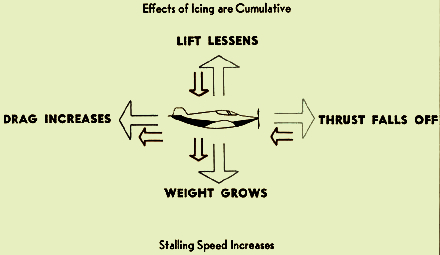
            1.A loss of aerodynamic efficiency due to reducing aircraft efficiency by increasing weight, reducing lift, decreasing thrust, and increasing drag.
            2. A loss of engine power; “Ice frequently forms in the air intake of an engine robbing the engine of air to support combustion. This type of icing occurs with both piston and jet engines, and almost everyone in the aviation community is familiar with carburetor icing. The downward moving piston in a piston engine or the compressor in a jet engine forms a partial vacuum in the intake. Adiabatic expansion in the partial vacuum cools the air. Ice forms when the temperature drops below freezing and sufficient moisture is present for sublimation. In piston engines, fuel evaporation produces additional cooling. Induction icing always lowers engine performance and can even reduce intake flow below that necessary for the engine to operate.”
            3. A loss of proper operation of control surfaces, brakes, and landing
gear. 
            4. A loss of pilot’s outside vision. 
            5. A false flight instrument indications; “Icing of the pitot tube reduces ram air pressure on the airspeed indicator and renders the instrument unreliable. Most modern aircraft also have outside static pressure port as part of the pitot-static system. Icing of the static pressure port reduces reliability of all instruments on the system - the airspeed, rate-of-climb, and altimeter.” 


            6. A loss   of   radio communication: “Ice forming on the radio antenna distorts its shape, increases drag, and imposes vibrations that may result in failure in the communications system of the aircraft.”

Knowing this will alert you to the remedies needed and required if you encounter icing and what necessary mitigation strategies you need to have to arrive safely on terra firma. Also the Icing Forecasts are to be taken with a grain of understanding. A Boeing encountering mild to moderate icing would be a “Blizzard” for a GA pilot. So Pireps from equivalent GA aircrafts have equivalency in meaning. Also the position where icing is reported does not stay static, it moves as weather moves therefore the playing field becomes wide open from a single pilot encounter.

And how to get out of the icing encounter:
  1. Never knowingly fly into known icing conditions even if equipped with anti-icing equipment. The freezing drizzle and or rain can quickly overwhelm all anti-icing functions.
  2. If you encounter rime icing which is mild with less than 1 inch of accumulation and no deviation in speed or control input keep flying but have an exit strategy.
  3. If accumulation exceeds your comfort zone of a thin layer to less than 1-inch accumulation ask for a deviation in altitude of up or down 2000 feet from your current altitude.
  4. If accumulation is moderate to heavy, change altitude, declare emergency and ask ATC for help in locating VFR conditions.
  5. If the horizontal stabilizer is iced fly the aircraft manually to determine the change in control surface function and the required input to determine the degree of lift destruction. The concept is to detect the loss of elevator effectiveness.
  6. Upon landing with structural icing do not extend flaps for change in the camber and loss of lift generation. Ice accumulation on the horizontal stabilizer is a potentially hazardous condition particularly during approach and landing. Extension of the flaps can increase the “downwash” that can seriously reduce tail-plane stall margin.
  7. Anticipate before drastic action has to be taken. In mixed or clear icing conditions even the hint would require you to take immediate action of deviation from altitude upwards to reach warmer temperatures aloft (Warm front over-riding a cold front). 90% of pilots gather information through visual cues, which is not reliable for aircraft mechanics. Here anticipation and mitigation of potential risks is a reliable means to flight safety. Accuracy of information regarding the atmospheric flight conditions and the Eigenstate of the aircraft determine the pilot’s ability to predict a potential stall. 89% pilots in simulator training wrongly predicted the stall state of the aircraft in icing conditions.
  8. Always fly manually in icing conditions since aircraft stall and elevator saturation can occur when the autopilot is engaged in altitude hold state. This altitude hold state with a roll command can saturate the vertical component of lift and lead to a stall in a turn.
  9. Once the ambient temperatures are below -20 degrees Celsius and the moisture falls as snow, flying is at best, bumpy. The snowflakes deflect of the airframe and do not accumulate.
  10. It is better to see snow and especially freezing rain from the comforts of an armchair.

Always have an exit strategy, a Plan B, an alternate option, another choice. Be Safe.

References:

  1. http://www.pilotoutlook.com/aviation_weather/icing
  2. Cloud Dynamic Structure by Professor Steven Rutledge, University of Colorado, June 3, 2009.
  3. Detection of the loss of elevator effectiveness due to aircraft icing. Robert H. Miller * William B. Ribbers, Department of Aerospace Engineering, The University of Michigan, Ann Arbor, MI 48109 AIAA-99-0637  
  4. European Aviation Safety Agency: British Airways, G-YMMM Boeing 777-236ER Accident.5. Smart Icing Systems for Aircraft Icing Safety, Michael Bragg et al, Univ of Illinois.
  1. The Ohio State University American Institute of Aeronautics & Astronautics 27/01/2009
  1. TP 185 - Aviation Safety Letter http://www.tc.gc.ca/CivilAviation/publications/tp185/1-07/Feature.htm
  2. Aircraft Icing handbook, Version 1, Civil Aviation Authority New Zealand.

Wednesday, December 15, 2010

The Seminar


A fictionalized, factual event.

What happened that February day is a remembrance of sorts, a conditional reminder of human desire and it’s failing. There was a loss of innocence, the dawn of a new understanding and all because of a man who dared to ask the question.


The podium was a two-step, navy-blue platform in front of a tall opaque blue-black curtain that formed the backdrop. Two huge screens draped the sides of the podium for those seated in the far back corners of the hall. The eight ornate chandeliers that dotted the beautifully carved ceiling of this majestic banquet hall were dimmed. The walls were replete with lit sconces of similar beauty adorning the great hall interspersed between each massive exit door. There were several hundred of us sitting in rows in this massive hall that seemed to stymie any attempt at creating an echo especially given its enormous size. One could hear the occasional cough and clearing of the throat or the clink of the pitcher of water decanting into a glass amidst the murmur..

The man who stood behind the dais had both his hands clenched around its edges as if squeezing every bit of energy to comply with the restraints of the time limit. He was done with his last slide presentation at the end of his allotted time, just when the green light on the dais had turned red. With that flourish of color that briefly illuminated his face, he stepped back and let his hands fall to his sides.


“Ladies and gentlemen, there will be a brief question and answer period that entails ten questions. Please answer the questions on the electronic device provided in front of you.”

After the Q&A session had concluded the moderator, a tall man with thick-rimmed glasses stood up and introduced himself. He rifled trough the questions, that had been provided instantaneously graphed into 3D Plots showing how the audience had responded to the multiple choice answers provided. Most of the answers seemed to follow a pattern of acceptance until the eighth question. This question asked if the audience was inclined to agree with experiment A that had been presented by Dr. Good to which 40% had answered in the affirmative and then the next question number nine, which asked the same question about experiment B that Dr. Great had presented to which another 40% agreed. The last question number ten, which asked, “Do you disagree with the two experiments?” was answered in the affirmative by the remaining 20% of the audience.


The lights flickered for a moment and then they came unglued to a full blaze. Everyone exited the room for a coffee break. The cacophony that followed this crowd could be heard easily in the adjoining corridors as the acoustic suppression tiles failed their leitmotif. All forms of expressions with hand gestures and body movements were in display. The supporters of the two experiments were firmly enshrined in their halls of decision.

Soon the coffee break was over and the gathering moved as a uniform controlled herd back through the portals of entry into the banquet hall. “So,” The moderator said as he cleared his throat from the remains of the cookie that he had just consumed with his coffee, “We will have ten minutes of questions from the audience and then present another set of questions for you to answer before starting the next item on the agenda.”


Several hands flew into the air and one by one agreements for each experiment were emphasized by the audience The questions were more like affirmations and as the preceding person asked the same question that the next one was contemplating, the upraised hands went down like dominoes. I noticed the person seated next to me raised his hand. 


He had been furiously working on the electronic devise in his hands.  When presented with the microphone, he proceeded to ask,  “Well if the data is robust on both sides and experiment A, states that the treatment was a success while experiment B shows no benefit by a different author there is something amiss here. Isn’t it? How can two supposedly very well designed and executed studies looking at benefit of the same drug in a given disease show dissimilar results?” He took a deep breath, “Unless there was bias?” The murmur in the hall became palpably uncomfortable amongst this august gathering of intellectually prone clinicians. The discomfiture shed it’s fear onto the two experimenters who now sat on the podium to the right of the dais where the moderator stood ready to answer any questions. But they were not expecting this. Both clasped their hands in unison and one actually crossed his legs.

“Well gentlemen how would you answer that question?”

There were excuses and replaying of the slides from the presentation as if to highlight the importance of the study and the rigor through which the study participants had been subjected and the data collection that had been reviewed by statisticians and worked through by the mathematical modeling software. The commotion seemed to abate as the discussion had taken up more time then intended. The moderator then asked for dimming of the lights and questions number 8,9 and 10 were asked again. The results were different. Now the answer to question number 10 was grossly skewed. Almost 80% were unsure of the two experiment results. The moderator displayed a graph on the screen and the audience broke out into spontaneous applause. The two experimenting authors seem to shrink into their seats with beads of sweat glistening on their respective foreheads.

The two boats of opposing opinions in this sea of knowledge, driven together by the clash of objectivity now were reduced to a raft-like state of a few wooden pieces bobbing up and down aimlessly. The passengers had bailed onto some other unsinkable Titanic that they hoped would carry them to their destination. Yet the lesson learnt was to question the improbable. Sometimes it is the minority opinion that breaks the stranglehold of conformity.


Medicine is the deep and wide ocean where complex thoughts, conflicting views and desires require careful scrutiny. A well-developed idea wins the stage for a brief moment then is readily obscured by a new paradigm. Time deems a hastily won contest a failure. It is the hard-fought intellectual enterprise that withstands the test.

The day ended with more presentations and much aplomb but it belonged to the lone voice that had surfaced and dared to look reality in her face.

Must we not question the seeds that may protect the very elements of our existence one day? Do we not lend ourselves to a critique on substance? Is it not ours to protect the future of the next generation? The answer to all the questions is an unqualified yes!

As the gentlest of gentle souls, I knew, who dwarfed the medical community once, said, “Go forth and question!”

Friday, December 3, 2010

My Little Patient


Oncology Times: 
25 November 2010 - Volume 32 - Issue 22 - p 38 
doi: 10.1097/01.COT.0000391442.94138.8f 
Poetry 
POETRY BY CANCER CAREGIVERS: “My little Patient” 

He sat rocking in the chair  
Wanting to purge the ill inside 
The ill that was, was so rare 
That no doctor-tools could subside 

His cherubic face fraught with concern 
His blue eyes wide with fear 
His gentle hands clasped in turn 
Waiting for the right words to hear 

A wisp of anger floated by 
Covered quickly by a resolute desire 
A cloaked cloud of inner fear 
Whelmed by the wanton fire 

Past care he was not 
Past cure he was 
Past love he was not 
Past anger he was 

So resolute in his desperation 
And frantic-mad in thought 
Random he was in conversation 
Held together by the fight he fought 

Many since have come and gone 
And many more will come and go 
Not any would look like him 
And not any would take a hold 

Memories linger as times pass 
Riddling the conscience with regret 
Oh how could he not be around 
When others who shouldn't, have 

The truth is vainly exposed 
For he grows more beautiful with time 
The little boy with a rare disease 
Holds the keys to our life's chime 

He lived when he lived 
Yet lives on after he died 
He touched whom he touched 
When life held him in stride

Now thrice his age so removed 
Yet twice the memories abound 
As twice the regret so grooved 
Brings thrice the desire and yearns 

He lives, though he died 
He died and so he lives 
Others live because he died 
He died so others can live 

Past care is never sought 
Past cure is sometimes found 
Past love is never thought 
When deep memories abound 

As Auden's falling torrent flows 
Shaking the assurance of any rose 
And Shakespeare's clock that tells the time 
Shows hideous night in violet's past prime 

With Cranch's rare rose's bloom foiled 
In death its matchless splendor spoiled 
Gives measure to the life's time 
Untrammeled lives, trampled never reaches prime 

My little patient lives, though he died 
A deep memory still so shocking 
That at times I wake up in the night 
And find him in the chair rocking.

PARVEZ DARA, MD, a hematologist/oncologist in Toms River, NJ, also has a blog, “The Arts, 
Sciences and Medicine: The Physician and the art of science and science of medicine,” at 
http://jedismedicine.blogspot.com 

© 2010 Lippincott Williams & Wilkins, Inc.